- An ISO Certified Company
Where to Start with Home Automation? A Complete Beginner’s Guide
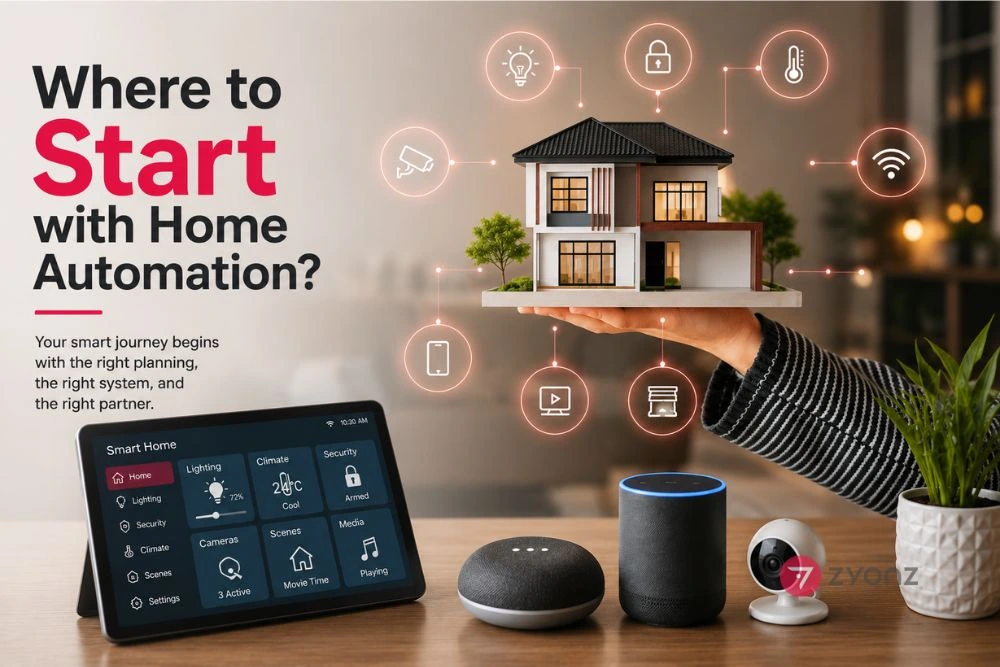
Home automation is no longer limited to luxury properties or futuristic homes. Today, homeowners can automate lighting, air conditioning, curtains, security systems, entertainment, and energy management to make everyday life more convenient, comfortable, and secure.
However, getting started with home automation can feel overwhelming. With so many devices, technologies, brands, and automation options available, many homeowners wonder: Where should I start with home automation?
The answer is simple: start with your lifestyle and requirements rather than the technology itself.
This guide explains the essential steps to plan a smart home, choose the right automation systems, and create a solution that can grow with your needs.
What Is Home Automation?
Home automation involves connecting different systems and devices in your property so they can be monitored and controlled automatically or through a centralized interface.
Depending on your requirements, a smart home can control:
- Lighting
- Air conditioning and climate control
- Curtains and blinds
- Home cinema
- Multi-room audio
- CCTV cameras
- Smart locks
- Video door phones
- Security alarms
- Access control
- Irrigation
- Garage doors
- Energy monitoring
Instead of operating each system independently, automation brings these functions together into a coordinated environment.
Why Should You Consider Home Automation?
Before choosing products, it is important to understand what you want automation to achieve.
A well-designed system can provide:
Convenience
Control multiple devices from a smartphone, tablet, touch panel, or voice assistant.
Comfort
Automatically adjust lighting, temperature, curtains, and entertainment according to your preferences.
Security
Monitor your property remotely and receive alerts about unusual activity.
Energy Efficiency
Automate lighting and HVAC systems to minimise unnecessary energy consumption.
Personalization
Create scenes and routines that make your home respond to different activities and times of day.
Step 1: Identify Your Home Automation Goals
The best place to start is by identifying the problems you want automation to solve.
Ask yourself:
- Do I want easier lighting control?
- Do I want to reduce energy consumption?
- Do I need better home security?
- Do I want automated curtains?
- Do I want to control my air conditioning remotely?
- Do I want a home cinema?
- Do I want to control everything from my phone?
- Do I want voice-controlled automation?
- Do I want my entire villa to be automated?
Your answers will help determine the right automation strategy.
Step 2: Decide What You Want to Automate
You don't necessarily have to automate everything at once.
Start with the systems that will provide the greatest value to your lifestyle.
Smart Lighting
Lighting is one of the easiest and most useful areas to automate.
You can control:
- Indoor lights
- Outdoor lights
- Garden lighting
- Decorative lighting
- Dimmable lights
You can also create scenes such as Good Morning, Dinner, Movie Night, Welcome Home, and Good Night.
Climate Control
Air conditioning is particularly important in the UAE climate.
Smart climate control can help you:
- Adjust temperature remotely
- Create schedules
- Control different zones
- Automate HVAC operation
- Reduce unnecessary cooling
A properly designed system can improve both comfort and energy efficiency.
Smart Curtains and Blinds
Motorised curtains and blinds can be controlled automatically based on schedules, sunlight, or your preferences.
For example, curtains can open in the morning and close automatically during the hottest part of the day.
Home Security
Smart security is another important starting point.
Your system can include:
- CCTV cameras
- Smart door locks
- Video door phones
- Motion sensors
- Door and window sensors
- Intrusion alarms
- Access control
You can also receive notifications and monitor your property remotely.
Home Entertainment
If entertainment is important to you, consider integrating:
- Home cinema
- Projectors
- Smart TVs
- Surround sound
- Multi-room audio
- Streaming systems
These can be connected with lighting, curtains, and climate control to create complete entertainment scenes.
Step 3: Consider the Type of Property
Your property plays an important role in deciding which automation technology is suitable.
New Villa or New Construction
If you are building a new villa, consider a professionally designed wired automation system.
The wiring can be planned during construction, making it easier to integrate lighting, climate control, security, curtains, and other systems.
Technologies such as KNX home automation are particularly suitable for large and premium residential projects.
Existing Villa
Existing properties can also be automated. Depending on the infrastructure, you can choose wired, wireless, or hybrid solutions.
Apartment
Wireless or hybrid automation can be a practical option for apartments where extensive wiring may not be possible.
Step 4: Choose Between Wired, Wireless, or Hybrid Automation
One of the most important decisions is choosing the communication technology. Also read the detailed differences b/w wired and wireless home automation.
Wired Home Automation
Wired systems use dedicated cables to connect automation devices.
Benefits
- Excellent reliability
- Stable communication
- High scalability
- Suitable for large properties
- Excellent long-term performance
Wired automation is particularly suitable for new villas and large residential or commercial projects.
Wireless Home Automation
Wireless systems communicate using technologies such as Wi-Fi, Zigbee, Z-Wave, Bluetooth, or Thread.
Benefits
- Easier installation
- Suitable for existing properties
- Minimal construction work
- Flexible expansion
- Lower installation complexity
Wireless automation can be particularly useful for apartments and existing homes.
Hybrid Automation
A hybrid system combines wired and wireless technologies.
For example, critical systems such as lighting and HVAC can use wired automation, while certain sensors and smart devices can communicate wirelessly.
For many properties, a hybrid approach provides an excellent balance between reliability and flexibility.
Step 5: Choose the Right Automation Platform
Once you know what you want to automate, choose a platform that can support your current and future requirements.
For larger villas and premium projects, an open automation standard such as KNX can provide extensive integration and scalability.
KNX can integrate systems such as:
- Lighting
- HVAC
- Curtains
- Security
- Energy management
- Audio-visual systems
The key is to choose a platform that allows your home to evolve rather than forcing you to replace the system whenever your needs change.
Step 6: Plan Your Automation Around Scenes
A smart home becomes truly useful when individual devices work together.
Instead of controlling every device separately, create scenes based on your daily activities.
Welcome Home
When you arrive:
- Entrance lights turn on
- Selected indoor lights activate
- Curtains open
- Air conditioning adjusts
- Security system changes mode
Good Night
Before going to bed:
- Selected lights turn off
- Curtains close
- Doors lock
- Security sensors activate
- Air conditioning adjusts
Movie Night
With one command:
- Lights dim
- Curtains close
- Projector turns on
- Home cinema activates
- Ambient lighting adjusts
This type of integrated automation is what makes a smart home feel truly intelligent.
Step 7: Think About Energy Efficiency
Home automation isn't only about convenience.
It can also help reduce unnecessary energy consumption.
For example, your system can:
- Turn off lights when rooms are unoccupied
- Adjust air conditioning according to schedules
- Use occupancy sensors
- Control lighting based on daylight
- Monitor energy consumption
- Automate curtains to manage sunlight
In a UAE home, intelligent climate and lighting management can be particularly valuable because of the high demand for cooling throughout much of the year.
Step 8: Plan Your Network Infrastructure
A reliable network is an important part of a modern smart home.
Depending on the size and complexity of your property, you may need:
- High-quality Wi-Fi
- Wired Ethernet connections
- Network switches
- Proper router placement
- Wi-Fi access points
- Structured cabling
- Network security
Don't treat networking as an afterthought. A poorly designed network can affect the performance of connected smart devices.
Step 9: Consider Future Expansion
Your smart home should be designed for tomorrow, not just today.
You may initially want lighting and curtains but later decide to add:
- Home cinema
- Security systems
- Energy monitoring
- Smart irrigation
- Multi-room audio
- EV charging integration
- Advanced climate control
Choosing a scalable platform allows these features to be added without completely redesigning your system.
Step 10: Set a Realistic Budget
Home automation costs can vary considerably depending on:
- Property size
- Number of rooms
- Automation features
- Wired or wireless infrastructure
- Number of devices
- Brand selection
- Level of customization
- Installation requirements
- Integration complexity
Instead of focusing only on the lowest initial price, consider the long-term value of the system.
A professionally designed system can provide better reliability, easier maintenance, and greater flexibility for future upgrades.
DIY vs Professional Home Automation
Some smart devices are simple enough for homeowners to install themselves. However, whole-home automation is significantly more complex.
DIY solutions may be suitable for:
- Smart bulbs
- Smart plugs
- Individual smart speakers
- Basic sensors
- Standalone devices
Professional automation is more suitable when you want multiple systems to work together.
A professional installer can help with:
- System design
- Product compatibility
- Electrical planning
- Network infrastructure
- Automation programming
- System integration
- Testing
- Commissioning
- Maintenance
Why Professional Home Automation Design Matters
A smart home isn't simply a collection of smart devices.
The real value comes from how those devices communicate and work together.
Professional planning can help you avoid:
- Incompatible products
- Weak network coverage
- Poor device placement
- Limited scalability
- Complicated controls
- Difficult maintenance
- Unnecessary installation costs
A professional automation company can evaluate your property and develop a solution around your lifestyle, rather than simply selling individual products.
Common Home Automation Mistakes to Avoid
Automating Everything Without a Plan
More automation isn't always better. Focus on the functions that genuinely improve your lifestyle.
Choosing Devices Based Only on Price
Low-cost products may not provide the reliability, integration, or support needed for a complete smart home.
Ignoring Network Infrastructure
A reliable network is essential for many connected devices.
Not Planning for Expansion
Avoid choosing a system that cannot accommodate future requirements.
Overcomplicating Controls
A smart home should make life easier. Controls should be simple and intuitive.
Skipping Professional Commissioning
Proper programming and testing can make a significant difference to the performance of the final system.
A Simple Way to Start Your Smart Home
If you're completely new to home automation, you don't have to automate the entire property immediately.
A practical starting point could be:
Phase 1
- Smart lighting
- Smart switches
- Smart curtains
Phase 2
- Climate control
- Security systems
- Smart locks
Phase 3
- Home cinema
- Multi-room audio
- Energy monitoring
Phase 4
- Advanced scenes
- Full-home integration
- Remote monitoring
- Additional smart systems
This phased approach allows you to build your smart home gradually while keeping future expansion in mind.
Why Choose Zyonz Technologies?
Zyonz Technologies, the best home automation company in Dubai, provides customised home automation solutions for residential and commercial properties across the UAE.
Our team can help you with every stage of your automation project, including:
- Consultation
- System design
- Product selection
- Installation
- Programming
- Integration
- Testing
- Commissioning
- Training
- Maintenance
- Technical support
From smart lighting and climate control to KNX home automation, home cinema, security, and energy management, we create integrated solutions based on your property's requirements and lifestyle.
Final Thoughts: Where Should You Start with Home Automation?
The best way to start with home automation is to identify your needs first and choose the technology second.
Think about what you want your smart home to achieve, whether that's better security, easier lighting control, improved energy efficiency, greater comfort, or a complete connected lifestyle.
From there, consider your property type, automation technology, budget, network infrastructure, and future requirements. A well-planned system can start small and grow with your home.
For villas, apartments, and commercial properties in the UAE, professional design and installation can ensure that all your smart systems work together reliably and intuitively.
With the right planning, home automation isn't about adding more technology to your home. It's about creating a space that works smarter for you.
Your Questions Answered
Explore our frequently asked questions to find answers to common queries about our in Dubai. If you can't find what you're looking for, feel free to contact us for further assistance.
 Categories